



Last week, Gregory walked through how to use the Convening Formats Guide: the three moments to reach for it, and an invitation to check one upcoming gathering against the cheat sheet. That video built on the question Carmen asked the week before: What if we started with the outcome we want instead of the format we’re most familiar with?
This week, we want to slow down and show you what that actually looks like in practice.
It started with a word: retreat
We work with a lot of organizations that call their gatherings retreats. Many of them aren’t. There’s nothing wrong with that on its own, but the name sets expectations, and the expectations shape everything that follows.
We saw this with a national partner of ours. They were planning what they called a retreat. Participants came expecting what a retreat promises: spaciousness, unprogrammed connection with other team members, time to breathe and rejuvenate. But the purpose of the gathering was to get real strategic work done.
Experiences like this one are part of why we created the guide. Here’s how it names what we saw.
On the cheat sheet, a retreat is “a convening designed for spaciousness.” The Meeting page goes further: “Calling a two-day meeting a ‘retreat’ does not make it one.” Then there’s the Planning or Work Session page, which describes the format as one that “lives in the space between a meeting and a retreat, and too often gets confused with both.” Its lens names the exact risk we were seeing: “treating a planning session like a retreat (promising spaciousness you do not intend to deliver).”
That was the gathering we had been designing. So we renamed it: an in-person strategy session.
The shift was immediate. Participants arrived ready to roll up their sleeves for discussion and strategy, instead of quietly wondering where the spaciousness went. The agenda didn’t have to fight the expectations, because the name finally matched the work.
We’ve made the same change in our own work at Can’t Stop! Won’t Stop! Consulting and are continuing to invite other clients into this shared language. When a gathering is built for producing something together, we call it a strategy or work session. Naming a format honestly helps everyone know what to expect and how to show up.
Three moments to reach for the guide
That story is one example of the first moment in the guide’s “How To Use” section. Here are all three.
1. Before you plan. Scan the formats and check your default. Is the format you reached for the right container for what the room needs? Sometimes the most important design decision is what you call it.
2. When something isn’t working. Find the format you’re using and read the lens. It may name what you’ve been feeling but couldn’t put into words.
We supported another national organization whose convening leaned on panels with too many people on stage at one time. Each panelist had time for introductions and maybe one or two questions (and let’s face it, people always speak longer than planned). Participants kept telling us they wanted to follow up and go deeper. So the organization tried a fireside chat with only two people. Fewer voices on stage created room for depth, vulnerability, and real engagement with the audience.
3. When you want to try something new. Look at the formats you’ve never considered. Some of the most powerful ways people come together are the ones professionals never think to use: the barbershop or salon, the shared meal, the pop-up, or the convention.
Two questions that can reset any meeting
You don’t need a big convening to use the guide. Its foundation is two questions from our very first piece, What Is a Convening? (And What Isn’t One?):
What is the intent?
Who is being centered?
We recently used them to reset one of our own staff meetings. We simply asked our team: What do you understand the intent of this meeting to be? And who is being centered?
It was a simple exercise, and it gave everyone a clear, concise shared understanding of why we were in the room and who the meeting was for. Try it at the start of your next team meeting. The answers will tell you a lot, especially if they don’t match.
Your invitation
Pick one gathering on your calendar in the next 90 days. Open the cheat sheet and find the format you defaulted to. Then ask the two questions. If the name doesn’t match the intent, change it.
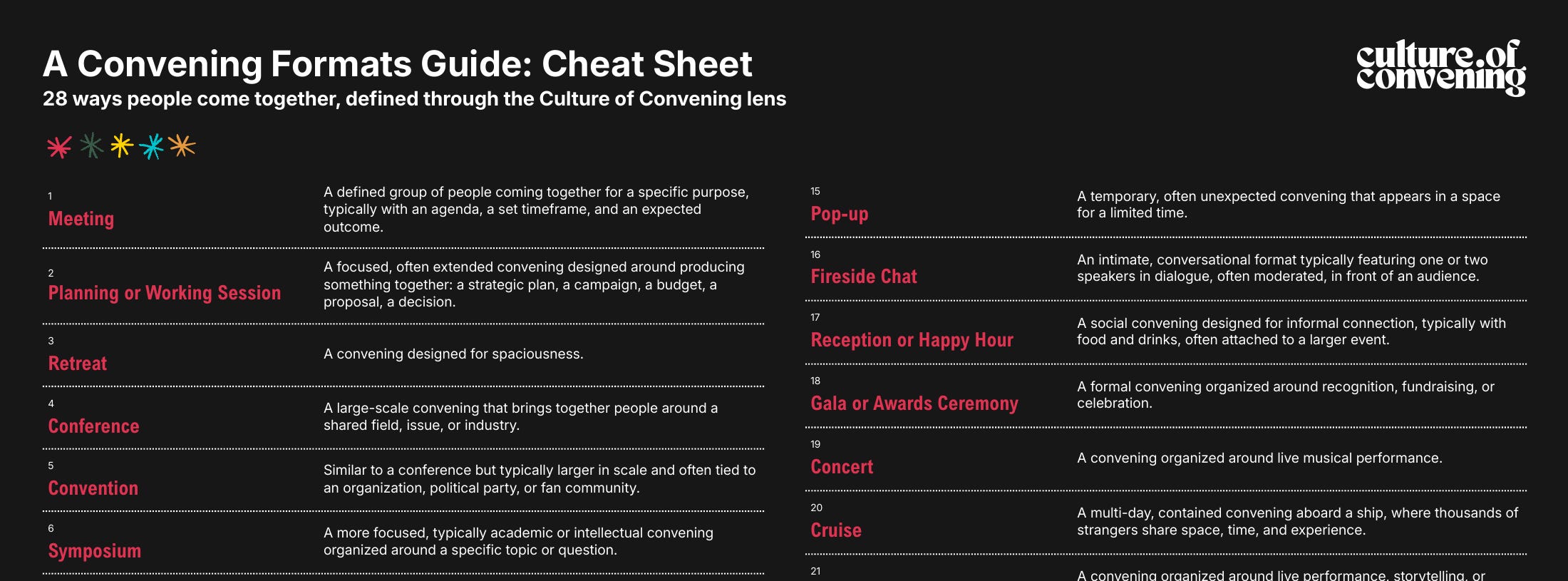
👉🏽 [Download the free cheat sheet] https://www.cultureofconvening.com/cheat-sheet
👉🏽 [Subscribe to get the full guide] https://www.cultureofconvening.com/guide
We’d love your input: Which gathering are you renaming? Are you trying a different format? Tell us in the comments.
Redefining the tradition of coming together, where every identity, experience, and perspective belongs.
– Carmen and Gregory
P.S. This conversation is better with more people in the room. If this sparked something for you, forward it to a colleague, a fellow facilitator, or that friend who’s always the one holding the space. And if someone sent this to you, welcome to the Culture of Convening Crew. Subscribe so you don’t miss what’s next.
P.P.S. Today is Election Day. Polling places are an important convening space many of us share, where every voice is meant to count the same. If you haven’t voted yet, find your polling place through your state’s election website and make a plan to get there.