

If You Can’t Feed the Room, You’re Not Ready to Convene It
Logistics are not separate from the program. They are the program.


I need you to think about the last convening you attended where someone asked you to fill out a dietary form.
Now think about whether what you wrote on that form actually showed up on your plate.
If you are pescatarian (like me), vegetarian, vegan, gluten-free, halal, kosher, diabetic, or allergic to something that could send you to the hospital, you know exactly what I am talking about. You filled out the form. You were specific. You showed up. And then you watched a catered lunch arrive that had one sad option for you, or no option at all, or an option that required you to go find someone, explain your needs again, and wait while everyone else ate.
And then someone asked you to be fully present for the afternoon session.
This is not a catering problem. This is a convening problem.

The Logistics Lie
There is a lie that lives inside most convening planning processes, and it goes like this: the program is the convening, and logistics are just the stuff around it.
The program is the keynote, the panels, the workshop or breakout sessions, the facilitated discussions. That is the “real” work. The logistics, food, space, temperature, accessibility, are treated as operational details. They get handed to a different team. They get a smaller budget. They get less attention. And when money gets tight, they are the first things cut.
But here is what I have learned from years of facilitating: a person whose needs are not being met is not present. They are managing. They are calculating. They are spending energy figuring out how to get through the day instead of engaging with the content, the people, or the purpose of being there.
You cannot ask someone to bring their full self into a room that did not plan for their body.
“What Do You Need?” Is Not the Same as Meeting the Need
I want to name something that I see constantly in convening spaces: organizations will ask participants what they need. They will send a pre-survey. They will include a dietary section on the registration form. They will ask about accessibility, about pronouns, about mobility, about accommodations.
And then they will treat the answers as a logistical checklist instead of as convening design.
There is a difference. A logistical checklist says: we asked, we noted it, we will try to accommodate. Convening design says: the needs of the people in this room are shaping how we build this experience from the start.
When dietary needs are an afterthought, the message is: we planned the convening, and then we tried to fit you into it. When dietary needs are part of the design, the message is: we planned the convening around the people who would be in the room, and that included what they need to be nourished, sustained, and present.
That is a fundamentally different orientation. And the people on the receiving end can feel it immediately.
It Is Not Just Food
Food is the most visible example, but this pattern runs through everything:
The room temperature that is always set for the person who runs too warm, while half the room sits in sweaters they brought because they know from experience nobody will adjust it. The conference venue with beautiful programming on the second floor and no elevator for the person who uses a wheelchair. The 8 AM start time that assumes everyone has childcare, transportation, and the kind of morning schedule that allows them to be bright-eyed before coffee.
The convening that asks for pronouns on the registration form and then never uses them. The event that promotes itself as “inclusive” and then schedules the welcome reception at a bar, without considering who that excludes: people in recovery, people whose faith traditions do not include alcohol, people who simply do not feel safe in that environment.
Every one of these is a moment where someone’s access was treated as separate from the program. And every one of these is a moment where someone in the room learned that their needs were less important than the convener’s plan.
Share this article with a convener, planner,
and room-shaper you know!
The Budget Tells the Truth
I have sat in enough planning meetings to know where organizations actually put their money. And I have noticed a pattern: the budget for the stage is almost never the line item that gets cut.
The keynote speaker gets their full fee. The AV setup gets funded. The branded materials get printed. The photographer gets booked.
I have heard people say: “We need to trim the food budget.” Or: “Can we do boxed lunches instead?” Or: “Do we really need to accommodate every single dietary restriction?”
What that tells the people in the room is clear: the production matters more than you do. The image of the convening matters more than your experience of it. People will spend to look good. There will be cuts to save where they think you will not notice.
But people always notice. They notice when the budget was designed for the convener’s goals instead of for the participants’ needs. They notice when the stage gets funded and the food gets cut. They may not say it out loud, but they carry it. And it shapes whether they come back.
What Centering Actually Looks Like in Practice
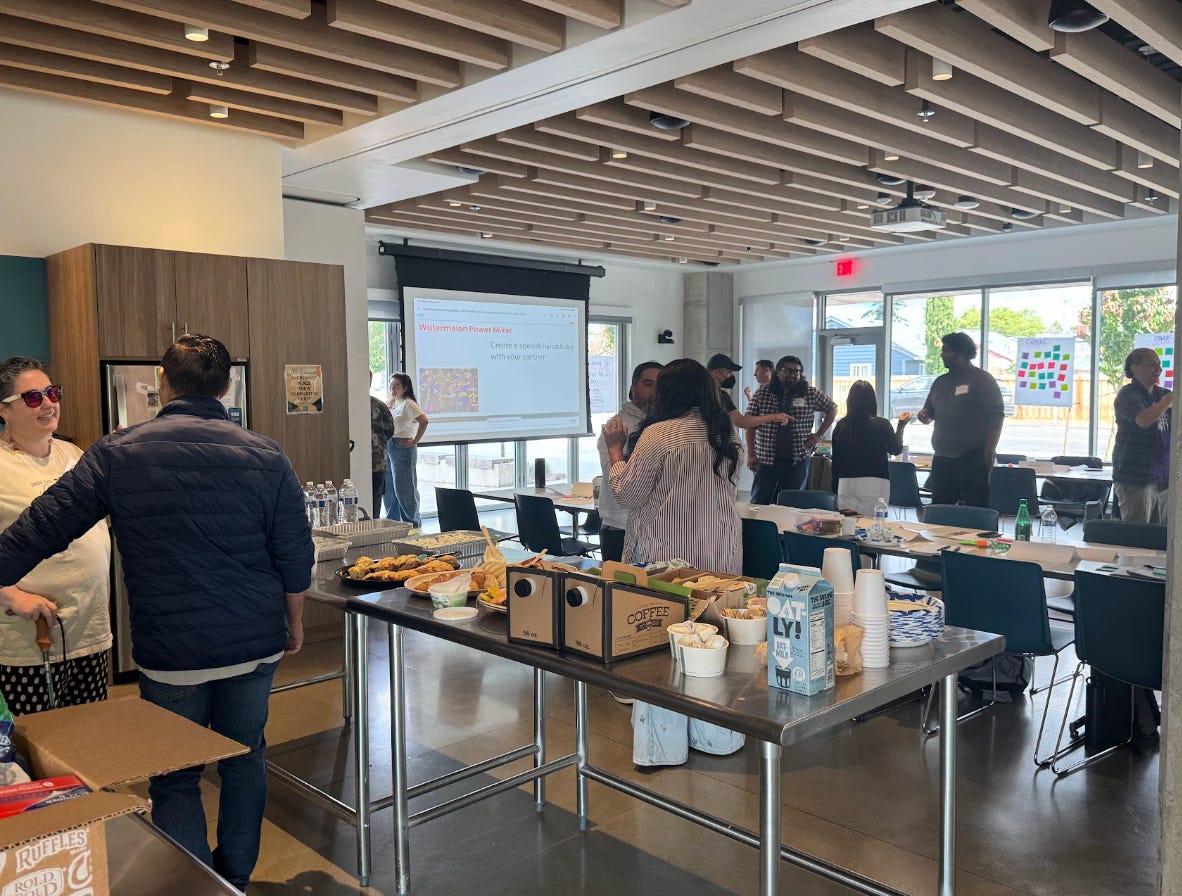
If you are designing a convening and you believe in centering the people in the room, here is what that looks like when it comes to the so-called logistics:
Ask early, and mean it. When you send the pre-survey, do not treat dietary and accessibility questions as formalities. Treat them as design inputs. If someone tells you they are gluten-free, that is not a note for the caterer. That is information that should shape your food planning from the start.
Budget for the people, not just the program. Before you book the keynote or speakers, ask yourself: have I budgeted enough to feed everyone in this room well? Have I accounted for accessibility? Have I planned for the physical comfort of the participants, not just the visual presentation of the event?
Stop separating logistics from goals. The goal of your convening is not just what happens on stage. The goal includes whether people can actually be present. If half your room is hungry, uncomfortable, or calculating whether the building is accessible, you have not met your goal, no matter how good the panels or content were.
Follow through without being asked. When someone’s dietary need shows up on their plate without them having to ask for it again, that is a belonging moment. It says: we heard you, we planned for you, you do not have to advocate for your own basic needs in this space. That is centering.
I have written before about calm as a strategic advantage, about helping leaders move from reactivity to regulation and from pressure to purpose. But regulation is not possible in a room that has not met your basic needs. Purpose is hard to find when you are hungry, cold, or trying to figure out whether the building has a bathroom you can get to or use.
Logistics are not the stuff around the convening. They are the foundation of it. And the way you handle them tells every person in the room exactly how centered they actually are.
So before you finalize your next agenda, ask yourself: have I planned for the people, or have I planned for the show?
Because the people will remember which one you chose.
This conversation is better with more people in the room.
If this piece sparked something for you, forward it to a colleague, a fellow facilitator, or that friend who’s always the one holding the space. And if someone sent this to you, welcome. Subscribe so you don’t miss what’s next.
 | A guest post by
|