

The Barber Shop, the Salon, and the Spaces We Don’t Call Convenings, But Should
What Black gathering spaces taught us about trust, rhythm, and the traditions that help people feel held.


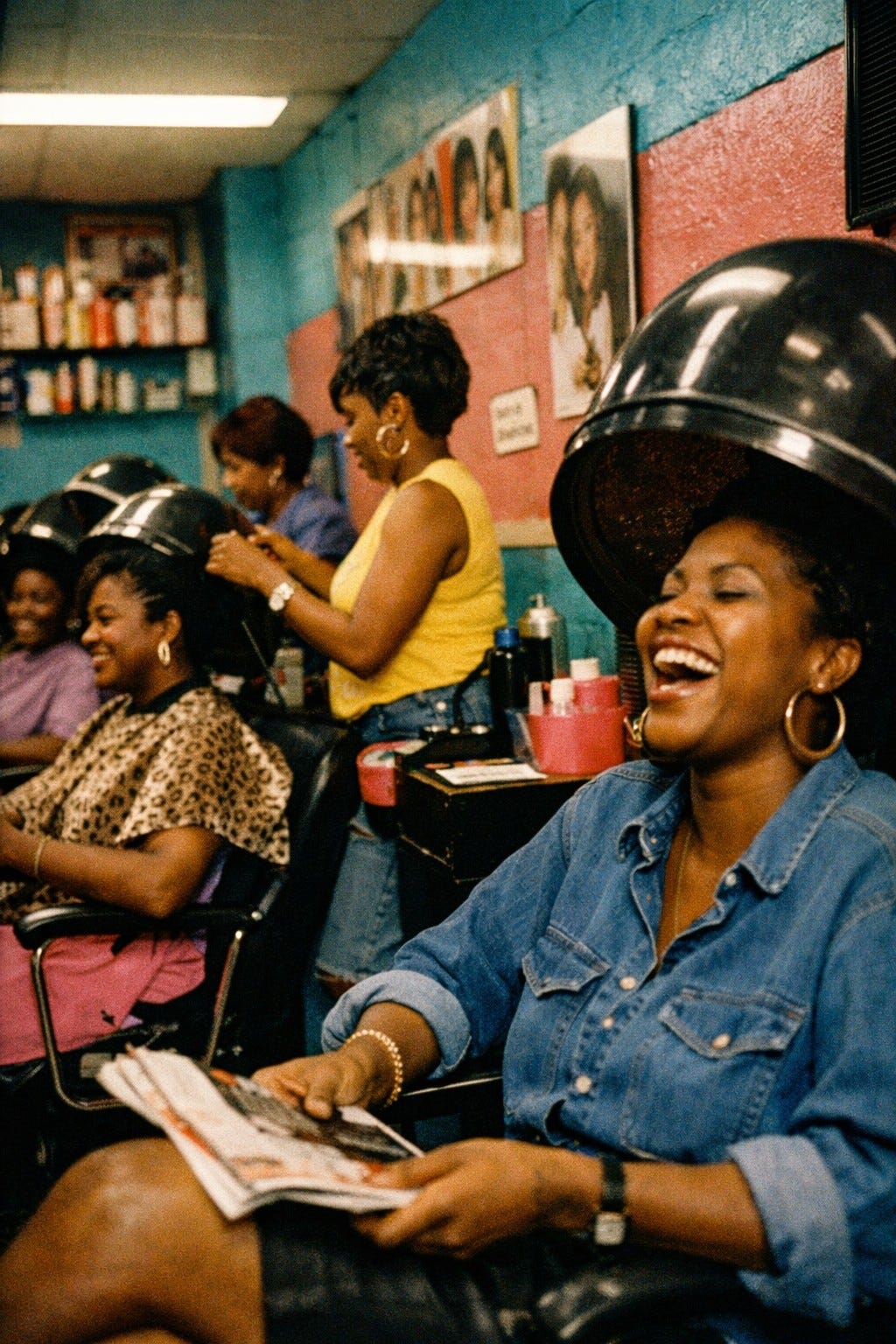
The Room Was Already Alive
One of the things I love most about Black spaces is that we know how to take something ordinary and make it an event.
A beauty shop. A barber chair. A church basement. A front porch. Give us somewhere to gather, and we will bring rhythm, commentary, laughter, style, and at least one person who knows everybody’s business but still somehow feels trustworthy.
My whole life, I have been getting my hair done. Braids, relaxers, curls, wraps, pin curls. If I added up the hours I have spent in a salon chair, it would be a gazillion.
And what I know for sure is that going to the salon was never just about hair.
It was a ritual. A world. A room that already knew itself before I walked in.
Usually, my mother would drop me off. I went to the same place my sister went to, which made me feel cool immediately. You got greeted when you came in. You got seen. You got folded into the life of the room before you ever sat down.
That matters.

More Than a Service
Stylists are never just stylists. They are therapists, aunties, truth-tellers, witnesses, and some of the greatest storytellers our communities have.
There are things I have told Wesley, Cheryl, Fela, Leila, and so many others that I have not told just anybody. Heartbreaks. Reinventions. Tiny revolutions. All of it spoken out loud while somebody stood behind me with a comb in one hand and a strong opinion in the other.
By the time I got out of that chair, I did not just look better. I often felt better.
Those older salon spaces were alive. Five to ten chairs going at once. Somebody is under the dryer. Somebody is arguing about politics. Somebody is laughing too loudly. And in the 90’s, somebody might be selling CDs, bootleg movies, or whole plates in the middle of all of it.
It was commerce, beauty, gossip, care, and culture all happening at once.
That was part of the point.
Share this article with a colleague, a fellow facilitator, or
that friend who’s always the one holding the space.
What These Spaces Know
Long before I had language for convening, I was learning from spaces like that.
They taught me that people gather differently when the room already has rhythm. When greeting is part of the culture. When waiting is not dead time, but part of the experience. When the space feels lived-in rather than staged.
That is a convening, even if nobody would have called it that.
It is also why I think we are far too narrow when we talk about gathering as if it only counts when there is a registration link, an agenda, and a bad hotel muffin.
Some of the best lessons about how people actually come together live in the spaces we rarely study, and almost never fund.
Not Perfect, Still Powerful
I do not want to romanticize these spaces.
They are not perfect. They are not automatically safe for everybody. Some people have experienced barber shops and salons as refuge. Others have experienced them as painful, exclusionary, or uncomfortable. Even that is part of the lesson.
Because these spaces make visible what every convening holds, spoken and unspoken rules about who belongs, who is centered, who gets corrected, who feels safe, and who has to translate themselves just to participate.
That is why they matter.
Not because they are flawless. Because they are real.
What Tradition Carries
The barber shop. The salon. The stoop. The porch. The church basement.
These were never just places to pass time. They were places that passed something down.
They taught us how to enter a room and how to be received. How to listen for the rhythm. How to hold somebody’s story with care. How to laugh in the middle of hard things. How to be seen before we had the language to ask for it.
That is what tradition can do at its best. It can carry love, memory, and a way of being together that outlives the people who first taught it to us.
Long before many of us ever sat in a conference room, we were already being formed in spaces that knew how to hold us.
And maybe that is why they still matter so much.
Because some of our first lessons in belonging did not come from institutions.
They came from the places that knew our names, our people, and the sound of our laughter before we ever knew how to name what it meant to belong.
This conversation is better with more people in the room.
If this piece sparked something for you, forward it to a colleague, a fellow facilitator, or that friend who’s always the one holding the space. And if someone sent this to you, welcome. Subscribe so you don’t miss what’s next.
 | A guest post by
|